Last updated on September 22nd, 2026 at 09:58 pm
In This Article
ToggleIntroduction
Have you ever wondered how tools like ChatGPT can answer questions, write articles, generate images, create code, and even help businesses automate daily tasks?
Behind many of these innovations is OpenAI, one of the world’s leading artificial intelligence companies.
Whether you’re a student, business owner, content creator, developer, or simply curious about AI, understanding OpenAI is becoming increasingly important. Its technologies are changing how people learn, work, communicate, and build software across almost every industry.
In this beginner-friendly guide, you’ll learn exactly what OpenAI is, how it works, who founded it, what products it offers, how businesses use it, and why it has become one of the most influential organizations in artificial intelligence.
By the end of this guide, you’ll have a clear understanding of OpenAI—even if you’ve never used AI before.
Quick Answer
What Is OpenAI?
OpenAI is an artificial intelligence research and technology company that develops advanced AI models capable of understanding and generating human-like text, images, code, speech, and other types of digital content.
The company’s mission is to develop artificial general intelligence (AGI) that benefits everyone. OpenAI is best known for creating products such as ChatGPT and APIs that developers and businesses use to build AI-powered applications.
Today, millions of people rely on OpenAI technologies for learning, writing, programming, customer support, research, education, and productivity. OpenAI Official Website
What Is OpenAI?
OpenAI is an AI research and deployment company focused on building intelligent systems that can assist humans with a wide range of tasks.
Unlike traditional software that follows fixed instructions, OpenAI develops AI models capable of learning patterns from vast amounts of information. These models can understand natural language, answer questions, summarize documents, write articles, translate languages, generate computer code, analyze data, and perform many other complex tasks.
OpenAI’s technology is designed to make artificial intelligence more useful, accessible, and safe for individuals, businesses, developers, educators, and organizations around the world.
Today, OpenAI powers some of the most widely used AI tools available online, including ChatGPT, advanced language models, image generation capabilities, and developer APIs.
What Does OpenAI Do?
OpenAI develops AI systems that help people complete tasks faster, more accurately, and more efficiently.
Its technology is used across many industries, including education, healthcare, software development, customer support, finance, marketing, and content creation.
Some of the most common things OpenAI can do include:
- Answer complex questions
- Write articles and emails
- Generate programming code
- Translate languages
- Summarize long documents
- Create marketing content
- Assist with research
- Analyze data
- Generate images
- Help businesses automate repetitive tasks
Instead of replacing human creativity, OpenAI aims to improve productivity by helping users complete work more efficiently.
Why Is OpenAI So Popular?
OpenAI became globally recognized after the launch of ChatGPT.
Millions of users quickly adopted the platform because it allowed anyone to interact with artificial intelligence using simple, natural language.
Unlike older AI systems that required technical knowledge, ChatGPT made AI accessible to everyday users.
Several factors contributed to OpenAI’s rapid growth:
- Easy-to-use interface
- Human-like conversations
- Fast response times
- Support for writing, coding, research, and learning
- Continuous model improvements
- Strong developer ecosystem
- Integration with business tools
As a result, OpenAI has become one of the most influential companies shaping the future of artificial intelligence.
History of OpenAI

Artificial intelligence has been studied for decades, but for many years it remained a technology used mainly by researchers and large organizations. While AI made progress in areas like image recognition and data analysis, there was still a need for more advanced systems that could understand and generate human language naturally.
To address this challenge, OpenAI was founded in December 2015 by a group of entrepreneurs, researchers, and technology leaders. Their goal was not just to build powerful AI but to ensure that artificial intelligence would benefit humanity as a whole.
From the beginning, OpenAI focused on conducting cutting-edge AI research while also promoting responsible development. Over the years, the organization evolved from a research lab into one of the world’s leading AI companies, creating technologies that are now used by millions of people every day.
Today, OpenAI is recognized for developing some of the most advanced generative AI models, including ChatGPT and powerful APIs used by developers and businesses worldwide.
Who Founded OpenAI?
OpenAI was founded by several well-known entrepreneurs and AI researchers who believed artificial intelligence could transform the future.
Some of the most recognized founders include:
- Sam Altman
- Elon Musk
- Greg Brockman
- Ilya Sutskever
- Wojciech Zaremba
- John Schulman
Each founder brought expertise in technology, artificial intelligence, software engineering, or business leadership. Their combined vision helped establish OpenAI as a leader in AI innovation.
Although some founders later left the organization, OpenAI continues to grow under the leadership of Sam Altman and its research team.
Why Was OpenAI Created?
OpenAI was created with a simple but ambitious goal: to develop advanced artificial intelligence that benefits everyone.
As AI technology became more powerful, experts recognized that it could bring enormous benefits—but also significant risks if developed without proper safeguards.
OpenAI was established to:
- Advance artificial intelligence research.
- Build AI systems that are useful for people.
- Improve AI safety and reliability.
- Make AI accessible to developers and businesses.
- Encourage responsible innovation.
- Help society prepare for increasingly capable AI systems.
Rather than focusing only on commercial success, OpenAI has consistently emphasized responsible AI development and long-term societal benefits.
OpenAI's Mission
OpenAI’s mission is:
To ensure that artificial general intelligence (AGI) benefits all of humanity.
Artificial General Intelligence, often called AGI, refers to AI systems that can perform a wide variety of intellectual tasks at or beyond human capability.
Although today’s AI models are highly capable, they are still considered narrow AI, meaning they are designed to perform specific tasks such as writing, coding, reasoning, or image generation.
OpenAI continues to invest in research aimed at making future AI systems more capable while also ensuring they remain safe, reliable, and aligned with human values.
Major Milestones in OpenAI's Journey
The table below highlights some of the most important milestones in OpenAI’s development.
| Year | Milestone |
|---|---|
| 2015 | OpenAI was founded. |
| 2016 | Began publishing advanced AI research. |
| 2018 | Introduced the first GPT language model. |
| 2019 | Launched a capped-profit structure and expanded research efforts. |
| 2020 | Released the OpenAI API for developers. |
| 2022 | Launched ChatGPT, bringing AI to millions of users. |
| 2023 | Expanded GPT capabilities with multimodal features and broader business adoption. |
| 2024–2026 | Continued improving AI models, enterprise solutions, developer tools, and multimodal technologies. |
These milestones demonstrate how OpenAI has evolved from a research organization into one of the most influential companies in artificial intelligence.
Microsoft's Partnership with OpenAI
One of the most significant developments in OpenAI’s growth has been its partnership with Microsoft.
Microsoft has invested heavily in OpenAI and integrated OpenAI technologies into several of its products and services.
This partnership enables:
- Faster AI research and development.
- Large-scale cloud computing infrastructure.
- AI-powered features across Microsoft products.
- Better tools for businesses and developers.
- Wider access to advanced AI technologies.
The collaboration has played an important role in making AI more accessible to organizations and individuals around the world.
How Does OpenAI Work?
OpenAI develops advanced AI models by training them on massive datasets that include books, articles, publicly available information, licensed content, and other educational resources.
During training, these models learn patterns in language, reasoning, programming, mathematics, and problem-solving.
When a user asks a question, the AI does not search the internet like a traditional search engine. Instead, it predicts the most appropriate response based on the patterns it learned during training and, in some products, may also use additional tools or connected data sources when available.
In simple terms, the process looks like this:
- The user enters a prompt or question.
- The AI analyzes the request.
- The model predicts the most relevant response.
- The answer is generated within seconds.
- The user can continue the conversation with follow-up questions.
This conversational approach is one of the key reasons why OpenAI’s products have become so popular with students, professionals, businesses, and developers.
OpenAI Products
OpenAI has developed a wide range of AI products and services designed for individuals, businesses, educators, and developers. Each product is built to solve different problems, from writing content and generating code to creating images and building AI-powered applications.
The table below provides a quick overview of OpenAI’s major products.
| Product | Primary Purpose | Best For |
|---|---|---|
| ChatGPT | AI chatbot for conversations and productivity | Everyone |
| OpenAI API | Build AI-powered applications | Developers & Businesses |
| GPT Models | Text generation, reasoning, coding | Developers |
| Sora | AI video generation | Creators & Businesses |
| DALL·E | AI image generation | Designers & Marketers |
| Playground | Experiment with AI models | Developers & Learners |
Let’s explore each product in more detail.
ChatGPT

ChatGPT is OpenAI’s most popular product and one of the world’s most widely used AI assistants.
It allows users to interact with AI using natural language. Instead of learning programming languages or complicated software, users simply type a question or request, and ChatGPT generates a response within seconds.
Millions of people use ChatGPT every day for work, education, research, business, programming, and creative projects.
What Can ChatGPT Do?
ChatGPT can help users:
- Write articles and blog posts
- Generate emails
- Answer questions
- Explain complex topics
- Summarize documents
- Translate languages
- Write programming code
- Debug software
- Brainstorm ideas
- Create marketing content
- Generate social media posts
- Help students study
Because of its versatility, ChatGPT has become one of the most popular AI tools available today.
GPT Models
GPT models are the core technology behind ChatGPT and many other OpenAI-powered applications.
These models are trained on vast amounts of text, enabling them to understand language, answer questions, generate content, write code, and perform reasoning tasks.
Over the years, OpenAI has released increasingly capable GPT models, each offering improvements in accuracy, reasoning, speed, and multimodal capabilities.
Common Capabilities of GPT Models
- Natural language understanding
- Content generation
- Coding assistance
- Mathematical reasoning
- Translation
- Text summarization
- Brainstorming
- Problem-solving
- Conversation
GPT models are used across industries including healthcare, education, finance, software development, and customer support.
OpenAI API

The OpenAI API allows developers to integrate OpenAI’s AI models into websites, mobile apps, and business software.
Instead of building AI systems from scratch, developers can access advanced AI capabilities through simple API requests.
Businesses use the API to create:
- AI chatbots
- Customer support systems
- Writing assistants
- Coding assistants
- Document summarization tools
- AI search experiences
- Translation applications
- Data analysis tools
The API is one of OpenAI’s most powerful offerings because it enables organizations to build customized AI solutions.
Sora
Sora is OpenAI’s AI video generation model.
It enables users to create realistic videos from simple text prompts.
For example, a user can describe a scene in plain English, and Sora generates a corresponding video.
Potential use cases include:
- Marketing videos
- Educational content
- Product demonstrations
- Storytelling
- Social media content
- Advertising
- Film pre-visualization
Sora represents an important step forward in generative AI by expanding beyond text into high-quality video creation.
DALL·E
DALL·E is OpenAI’s image generation model.
It creates original images based on text descriptions provided by users.
Designers, marketers, educators, and content creators use DALL·E to generate:
- Marketing graphics
- Blog illustrations
- Social media images
- Product concepts
- Book covers
- Presentation visuals
- Creative artwork
By turning text into images, DALL·E helps users create visual content without advanced graphic design skills.

Playground
Playground is a web-based environment where developers and learners can experiment with OpenAI models.
It provides greater control over prompts, model settings, and outputs than a standard chatbot interface.
Playground is commonly used for:
- Prompt testing
- API experimentation
- AI learning
- Model comparisons
- Prototype development
It is especially valuable for developers who want to understand how different AI models behave before integrating them into applications.
How OpenAI Products Work Together
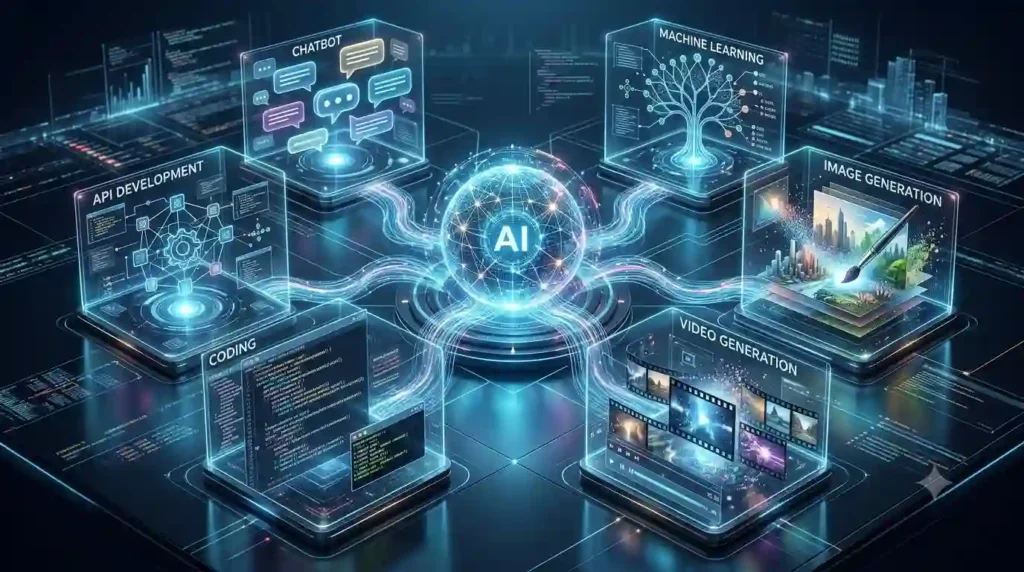
Although each OpenAI product serves a different purpose, they often complement one another.
For example:
- A marketer may use ChatGPT to write ad copy.
- They can use DALL·E to create promotional images.
- A video creator can generate scripts with ChatGPT and produce videos using Sora.
- A software company can integrate the OpenAI API into its application.
- Developers can test prompts in Playground before deploying them in production.
This connected ecosystem allows individuals and organizations to complete tasks more efficiently using AI.
Which OpenAI Product Should You Use?
The right OpenAI product depends on your goals.
| If You Want To… | Recommended Product |
|---|---|
| Ask questions and get instant answers | ChatGPT |
| Build AI-powered apps | OpenAI API |
| Generate images | DALL·E |
| Create AI videos | Sora |
| Test prompts and models | Playground |
| Develop AI software | GPT Models + API |
Choosing the right product ensures you get the best results while saving time and improving productivity.
Which OpenAI Product Should You Use?
Artificial intelligence is no longer limited to large technology companies. Today, businesses of all sizes use OpenAI to improve productivity, reduce costs, and automate repetitive tasks.
Instead of spending hours on manual work, companies can use AI to complete many tasks in minutes while allowing employees to focus on higher-value activities.
Some of the most common business applications include:
- Customer support automation
- Email writing
- Marketing copy generation
- Sales content creation
- Data analysis
- Report summarization
- Product descriptions
- Knowledge management
- Internal documentation
- Business research
By integrating OpenAI into their daily workflows, businesses can increase efficiency while maintaining high-quality output.
How Students Use OpenAI
OpenAI has become a valuable learning companion for students around the world.
Rather than replacing learning, AI can help students understand difficult concepts, organize study materials, and improve writing skills.
Students commonly use OpenAI to:
- Explain complex subjects
- Solve math problems step by step
- Practice coding
- Improve grammar and writing
- Summarize textbooks
- Generate study notes
- Create quizzes for revision
- Learn new languages
- Brainstorm project ideas
- Prepare for exams
Example
A biology student can ask ChatGPT to explain photosynthesis in simple language or create a short quiz for practice.
A programming student can request code examples and receive explanations for each line, making it easier to understand programming concepts.
How Developers Use OpenAI
Developers are among the biggest users of OpenAI technologies.
Instead of writing every line of code manually, developers use AI to accelerate software development while improving productivity.
Common developer use cases include:
- Code generation
- Bug fixing
- Code explanation
- API integration
- Documentation writing
- SQL query generation
- Testing assistance
- Refactoring existing code
- Learning new programming languages
- Building AI-powered applications
Many startups also use the OpenAI API to build intelligent chatbots, virtual assistants, and business automation tools.
How Content Creators Use OpenAI

Content creators can significantly reduce the time required to produce high-quality content.
OpenAI assists creators throughout the entire content creation process.
Popular use cases include:
- Writing blog posts
- Creating YouTube scripts
- Generating social media captions
- Brainstorming video ideas
- Creating email newsletters
- Writing product reviews
- Generating podcast outlines
- Creating ad copy
- Planning content calendars
Instead of replacing creativity, OpenAI helps creators work faster and overcome writer’s block.
OpenAI in Education
Educational institutions are increasingly adopting AI to improve teaching and learning experiences.
Teachers use OpenAI to:
- Create lesson plans
- Generate worksheets
- Prepare quizzes
- Explain complex topics
- Create classroom activities
- Provide personalized learning support
Students benefit from immediate explanations, practice questions, and interactive learning experiences.
However, educators also encourage students to use AI responsibly by verifying information and avoiding plagiarism.
OpenAI in Healthcare
Healthcare professionals are exploring AI to improve administrative efficiency and support decision-making.
Potential applications include:
- Summarizing medical documents
- Drafting clinical notes
- Medical research assistance
- Patient communication
- Administrative automation
- Knowledge retrieval
It’s important to note that AI should support healthcare professionals—not replace their medical expertise or judgment.
OpenAI in Marketing
Marketing teams use OpenAI to create campaigns faster while maintaining consistency across different channels.
Marketing use cases include:
- SEO content writing
- Product descriptions
- Advertising copy
- Landing pages
- Social media campaigns
- Email marketing
- Keyword brainstorming
- Audience research
- Content optimization
By automating repetitive writing tasks, marketers can focus more on strategy, creativity, and campaign performance.
Real-World Examples of OpenAI
The best way to understand OpenAI is by looking at how people use it in everyday life.
Example 1: Small Business Owner
A local business owner uses ChatGPT to write weekly email newsletters, create product descriptions, and respond to customer inquiries, saving several hours each week.
Example 2: College Student
A university student asks ChatGPT to explain difficult science concepts in simple language, summarize lecture notes, and generate practice questions before exams.
Example 3: Software Developer
A developer uses the OpenAI API to build an AI chatbot that answers customer questions 24/7, improving customer support while reducing response times.
Example 4: Digital Marketer
A marketing agency uses OpenAI to generate blog outlines, SEO-friendly headlines, ad copy, and social media content for multiple clients.
Example 5: Content Creator
A YouTube creator uses ChatGPT to write video scripts, DALL·E to create thumbnails, and Sora to experiment with AI-generated video concepts.
Benefits of Using OpenAI

OpenAI offers several advantages for individuals and organizations.
Key Benefits
- Saves time by automating repetitive tasks
- Improves productivity
- Supports creativity and brainstorming
- Assists with coding and software development
- Simplifies learning and education
- Enhances customer support
- Generates content quickly
- Supports multiple languages
- Integrates with business applications
- Helps organizations scale AI-powered workflows
These benefits have made OpenAI one of the most widely adopted AI platforms in the world.
Is OpenAI Right for Everyone?
OpenAI is designed to serve a wide range of users, but the best product depends on individual needs.
It is particularly useful for:
- Students
- Teachers
- Developers
- Business owners
- Researchers
- Writers
- Designers
- Content creators
- Marketing professionals
- Customer support teams
Whether you’re learning a new skill, building software, or growing a business, OpenAI provides tools that can simplify complex tasks and improve productivity.
OpenAI Pricing
One of the most common questions people ask is whether OpenAI is free to use.
The answer depends on which OpenAI product you want to use. OpenAI offers both free and paid options for individuals, businesses, and developers.
For example, ChatGPT includes a free plan that lets users experience AI for everyday tasks, while paid plans provide additional features such as higher usage limits, access to more advanced models, and faster performance.
Similarly, developers using the OpenAI API pay based on their usage, making it flexible for both small projects and enterprise applications.
Because OpenAI regularly updates its plans and features, it’s always a good idea to check the latest Open AI pricing before choosing a subscription.
Free vs Paid Plans
The following table provides a general comparison between free and paid options.
| Feature | Free Plan | Paid Plans |
|---|---|---|
| Basic AI access | ✅ | ✅ |
| Advanced AI models | Limited | More available |
| Faster responses | Limited | Yes |
| Higher usage limits | No | Yes |
| Priority access to new features | No | Yes |
| Suitable for | Casual users | Professionals & businesses |
If you’re just starting, the free plan is often enough to learn how OpenAI works. As your needs grow, you can decide whether a paid plan offers value for your workflow.
Is OpenAI Free?
Yes, many OpenAI services offer a free entry point, especially for new users who want to explore AI.
However, advanced capabilities, professional features, and higher usage limits may require a paid subscription or API credits.
For developers, API usage is generally billed based on how much you use the service.
Benefits of OpenAI
OpenAI has become one of the most popular AI platforms because it provides practical benefits for individuals and organizations.
Key Advantages
- Easy to use, even for beginners
- Saves time on repetitive tasks
- Improves writing and communication
- Helps developers write and debug code
- Supports learning and education
- Boosts business productivity
- Generates ideas and creative content
- Works across multiple industries
- Offers powerful APIs for developers
- Continuously improves with new features
Whether you’re writing emails, analyzing information, or creating marketing content, OpenAI can help complete tasks more efficiently.
Limitations of OpenAI
Although OpenAI is powerful, it is not perfect.
Understanding its limitations helps users use AI more effectively.
Some common limitations include:
- AI can sometimes generate incorrect information.
- Responses may require human verification.
- It does not replace professional legal, medical, or financial advice.
- Some features require a paid subscription.
- Performance depends on how clearly prompts are written.
- AI may occasionally misunderstand complex instructions.
The best results usually come from combining AI assistance with human judgment.
Is OpenAI Safe to Use?
OpenAI places a strong emphasis on AI safety and responsible development.
The company continuously works to improve model behavior, reduce harmful outputs, and make AI systems more reliable.
For most everyday tasks, OpenAI is considered safe to use. However, users should avoid sharing highly sensitive personal information unless they understand the privacy settings and terms of the specific product they are using.
As with any online service, it’s a good practice to review privacy policies and use strong account security measures.
Common Misconceptions About OpenAI
Many people have misunderstandings about OpenAI and its capabilities.
Let’s clear up a few common myths.
Myth 1: OpenAI Knows Everything
No. AI generates responses based on patterns learned during training and, depending on the product, may also use connected tools or data sources. It can still make mistakes.
Myth 2: OpenAI Replaces Human Jobs Completely
OpenAI is designed to assist people, not simply replace them.
Many professionals use AI to improve productivity while continuing to make important decisions themselves.
Myth 3: AI Is Always Correct
AI can provide impressive answers, but it can also make errors.
Important information should always be verified using reliable sources.
Myth 4: OpenAI Is Only for Programmers
Not at all.
Students, teachers, marketers, writers, researchers, designers, business owners, and many other professionals use OpenAI every day.
Tips for Getting the Best Results from OpenAI
The quality of AI responses depends heavily on the prompts you provide.
Here are a few tips to improve your results:
- Ask clear and specific questions.
- Provide enough context.
- Break complex tasks into smaller steps.
- Request examples when needed.
- Ask the AI to explain its reasoning in simple language.
- Review and edit important outputs.
- Experiment with different prompts.
- Verify facts before publishing or making decisions.
The better your prompt, the more useful the response is likely to be.
Who Should Use OpenAI?
OpenAI is suitable for a wide variety of users.
It can be especially valuable for:
- Students
- Teachers
- Developers
- Business owners
- Freelancers
- Digital marketers
- Bloggers
- Content creators
- Researchers
- Customer support teams
- Designers
- Software companies
Because of its flexibility, OpenAI can support both personal and professional tasks across many industries.
OpenAI vs ChatGPT
Many beginners think OpenAI and ChatGPT are the same thing, but they are different.
OpenAI is the company that researches and develops artificial intelligence technologies, while ChatGPT is one of the products created by OpenAI.
Think of it this way: OpenAI is like a technology company, and ChatGPT is one of its software products.
| Feature | OpenAI | ChatGPT |
|---|---|---|
| Type | AI Research & Technology Company | AI Chatbot |
| Main Purpose | Develop AI technologies | Help users with conversations and tasks |
| Users | Businesses, developers, researchers, consumers | General public |
| Includes | ChatGPT, API, DALL·E, Sora, GPT models | Conversational AI assistant |
If someone asks, “Who created ChatGPT?” the answer is OpenAI.
OpenAI vs Google Gemini
OpenAI and Google’s Gemini are two of the most advanced AI platforms available today.
While both provide AI-powered assistance, they have different strengths.
| Feature | OpenAI | Gemini |
|---|---|---|
| Best Known For | ChatGPT | Gemini AI |
| Company | OpenAI | |
| AI Models | GPT Series | Gemini Series |
| Coding | Excellent | Excellent |
| Writing | Excellent | Very Good |
| Ecosystem | API, ChatGPT, Sora, DALL·E | Google Workspace integration |
| Best For | General AI, developers, businesses | Google ecosystem users |
The right choice depends on your workflow and the tools you already use.
OpenAI vs Anthropic Claude
Anthropic is another leading AI company known for developing Claude.
Both companies focus on building advanced AI systems, but they have different products and design philosophies.
| Feature | OpenAI | Claude |
|---|---|---|
| Company | OpenAI | Anthropic |
| Main Product | ChatGPT | Claude |
| API | Yes | Yes |
| Coding | Excellent | Excellent |
| Writing | Excellent | Excellent |
| Business Use | Widely adopted | Widely adopted |
| AI Safety Focus | Strong | Strong |
Both platforms continue to evolve, and many businesses evaluate them based on pricing, features, integrations, and specific use cases.

Frequently Asked Questions (FAQs)
What is OpenAI in simple words?
OpenAI is an artificial intelligence company that develops AI models capable of understanding and generating text, images, code, and other forms of digital content.
Is OpenAI free?
OpenAI offers free access to some services, while advanced features and higher usage limits may require a paid subscription or usage-based billing.
Who owns OpenAI?
OpenAI operates under a unique organizational structure with leadership, investors, and strategic partnerships. It is not owned by a single individual.
Who founded OpenAI?
OpenAI was founded in 2015 by a group of entrepreneurs and AI researchers, including Sam Altman, Elon Musk, Greg Brockman, Ilya Sutskever, Wojciech Zaremba, and John Schulman.
Is ChatGPT the same as OpenAI?
No.
OpenAI is the company, while ChatGPT is one of the AI products developed by OpenAI.
What products does OpenAI offer?
OpenAI offers several products and technologies, including:
ChatGPT
GPT models
OpenAI API
DALL·E
Sora
Playground
Can students use OpenAI?
Yes. Students use OpenAI for learning, research, writing assistance, coding practice, language learning, and exam preparation.
Can businesses use OpenAI?
Yes. Businesses use OpenAI for customer support, marketing, software development, automation, analytics, and productivity.
Is OpenAI safe?
OpenAI invests heavily in AI safety and responsible development. However, users should always verify important information and avoid sharing sensitive personal data unnecessarily.
Does OpenAI replace human jobs?
OpenAI is designed to assist people and improve productivity. In many workplaces, AI is used alongside human expertise rather than replacing it completely.
Key Takeaways
Before you leave, here are the most important points to remember:
OpenAI is one of the world’s leading artificial intelligence companies.
It developed popular AI technologies like ChatGPT, GPT models, the OpenAI API, DALL·E, and Sora.
Millions of people use OpenAI for learning, writing, coding, business, and content creation.
OpenAI’s mission is to develop advanced AI that benefits humanity.
AI works best when combined with human knowledge and critical thinking.

Final Thoughts
Artificial intelligence is changing the way people learn, work, communicate, and solve problems, and OpenAI has played a major role in that transformation.
From helping students study and supporting developers in writing code to enabling businesses to automate workflows and creators to produce content more efficiently, OpenAI has made advanced AI more accessible than ever before.
Whether you’re just beginning your AI journey or looking for professional tools to improve productivity, understanding what OpenAI is and how its products work provides a strong foundation for exploring the rapidly evolving world of artificial intelligence.
As AI technology continues to advance, staying informed about OpenAI’s products, updates, and best practices will help you make smarter decisions and get the most value from these powerful tools.


Pingback: 9 Best AI Text Generator Tools in 2026 (Tested & Ranked)